
Maintaining a stable marine environment is the cornerstone of a successful reef aquarium. Unlike freshwater aquatics, where water parameter tolerances are often broad, a marine system demands surgical precision. Two global market leaders – Dutch drip test manufacturer Salifert and American digital colorimetry giant Hanna Instruments (Checker series) – offer the most popular solutions for monitoring critical parameters. The choice between them often becomes a stumbling block for aquarists of all levels.
1. Tests for Marine Aquariums: Salifert vs. Hanna Checker – A Full Review

Marine aquatics, especially those containing hard corals (SPS — Small Polyp Stony), require regular and accurate measurement of key chemical indicators. Even a slight deviation can lead to stress, bleaching, or coral death. Aquarists face a choice: use traditional, time-tested titration methods or switch to fast and objective digital meters.
Salifert has been the industry standard for decades. These are classic drip tests based on titration, where a color change of the reagent signals the endpoint of the reaction. They require attention and good lighting.
Hanna Checker represents compact digital colorimeters. These devices measure the intensity of the color that a water sample acquires after adding a reagent and display the result as a precise number. This method eliminates subjective human color assessment.
2. Why is Water Testing in a Marine Aquarium So Important?
Life in a reef aquarium, whether fish, invertebrates, or corals, depends on a narrow range of chemical indicators. The main parameters that need to be monitored with the highest accuracy are divided into two groups:
Parameters Affecting Coral Growth (Balance Elements):
- Alkalinity (KH): Measured in dKH or meq/L. Critically important for pH stability and is a building material for coral skeletons. Range: 7.5–9.0 dKH.
- Calcium (Ca): The primary building block. Must be in balance with alkalinity. Range: 400–450 ppm.
- Magnesium (Mg): Necessary to prevent premature calcium precipitation and maintain the correct Ca/Alk ratio. Range: 1250–1350 ppm.
Parameters Affecting Water Clarity and Health:
- Nitrate (NO3): The end product of the nitrogen cycle. High levels are toxic. For SPS corals, ultra-low levels (0.2–5 ppm) are desirable.
- Phosphate (PO4): The main source of nutrition for algae and cyanobacteria. Extremely toxic to corals in high concentrations. For reefs: 0.03–0.07 ppm.
3. Salifert: A Time-Tested Drip System
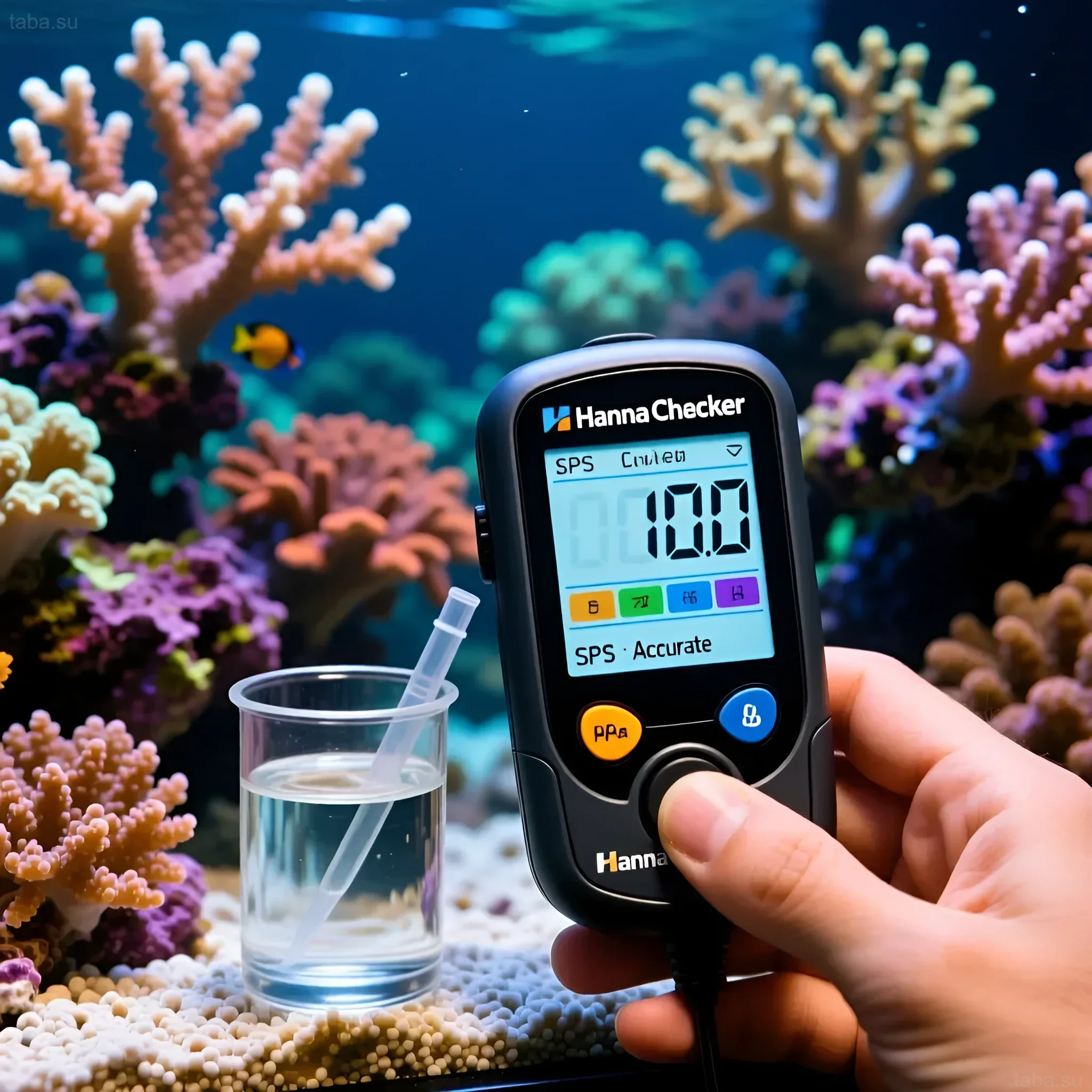
Salifert tests have earned a reputation for being reliable and cost-effective tools. They work on the principle of titration, where the aquarist adds reagent drop by drop until the solution changes color, marking the endpoint.
Salifert Advantages:
- Cost-effectiveness: The cost per test is typically significantly lower than using a Hanna Checker.
- Wide Range: Salifert offers tests for almost all necessary parameters, including iodine, strontium, and bromine.
- High Concentration: Ideal for measuring parameters requiring high concentrations (Ca, Mg, Alk) as they use a larger sample volume.
- Availability: Easily found in most aquarium stores.
Salifert Disadvantages:
The main drawbacks are related to subjectivity and the need for precise dosing:
- Subjectivity: Determining the titration endpoint (the moment of color change) depends on lighting and the aquarist’s color perception. This is particularly challenging when measuring nitrates and phosphates, where color transitions can be subtle.
- Difficulty for Beginners: Some tests (e.g., magnesium) require a multi-step process and precise drop counting.
- Low Range: For ultra-low concentrations (e.g., 0.03 ppm phosphates), drip tests are less accurate than digital ones.
4. Hanna Checker: Digital Testing for Maximum Accuracy
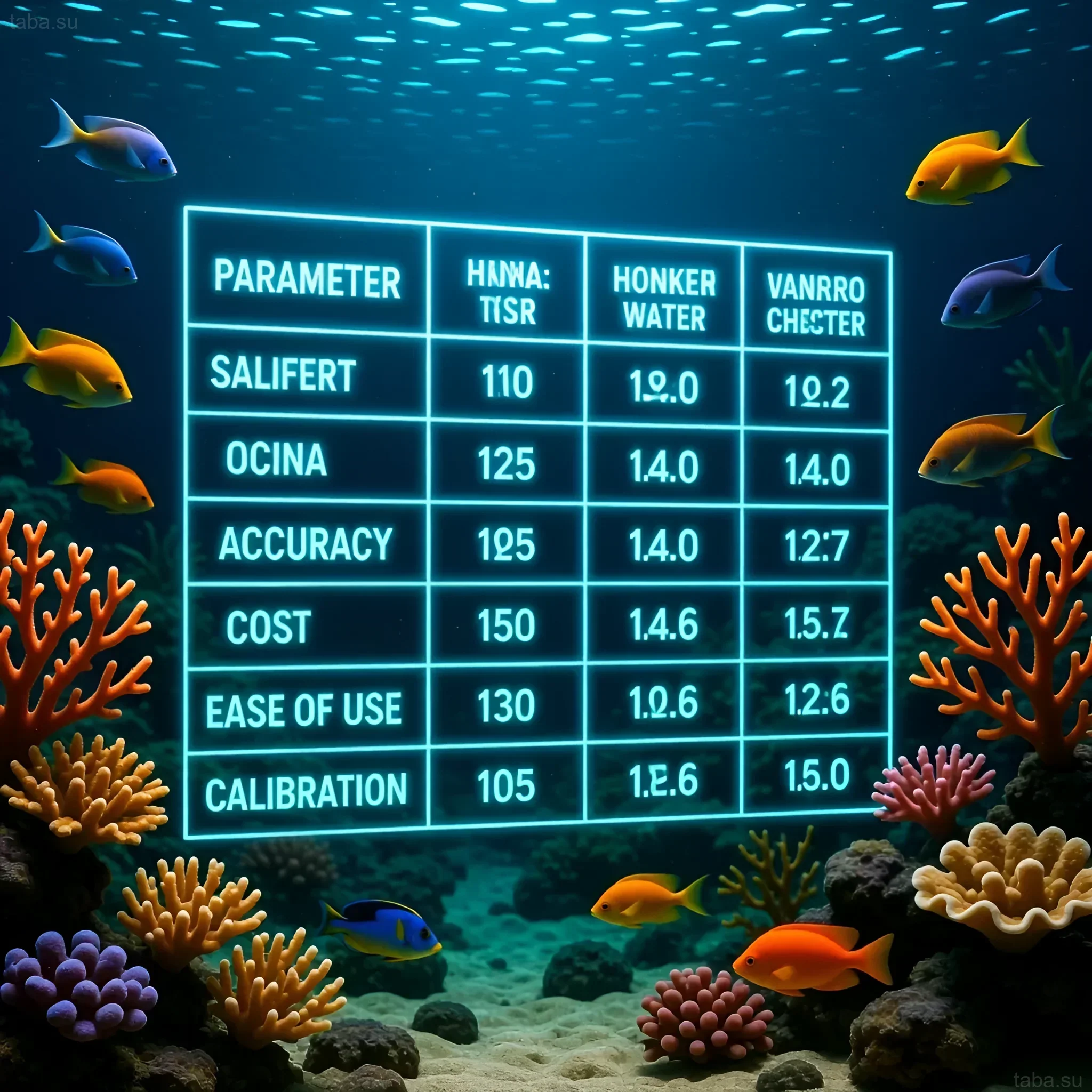
Hanna Checker (e.g., HI736 for ultra-low phosphates or HI781 for alkalinity) are mini-colorimeters that provide objective and fast results. The principle of operation is based on the Beer-Lambert Law: the higher the concentration of a substance, the more light of a specific wavelength is absorbed by the colored solution.
Hanna Checker Advantages:
- Objectivity and Accuracy: Eliminates the human factor. The device always determines color consistently, ensuring high result repeatability.
- Ultra-Low Ranges: Hanna excels over drip tests in measuring critically low concentrations, such as phosphates and nitrates, which is vital for SPS aquariums.
- Ease of Use: The process consists of three steps: adding reagent, inserting the cuvette into the device, and reading the result.
- Speed: Results are typically ready within 3–5 minutes.
Hanna Checker Disadvantages:
- Cost: High initial cost of the device. Reagents are also more expensive than Salifert’s.
- Limited Range: A separate device is required for each parameter (PO4, NO3, Alk, Ca).
- Reagents: Reagents are supplied as powder or liquid in individual packets, which can be less convenient than Salifert’s bottles.
- Shelf Life: Some Hanna reagents have a relatively short shelf life after opening.
5. Salifert vs. Hanna Checker: Parameter and Price Comparison Table
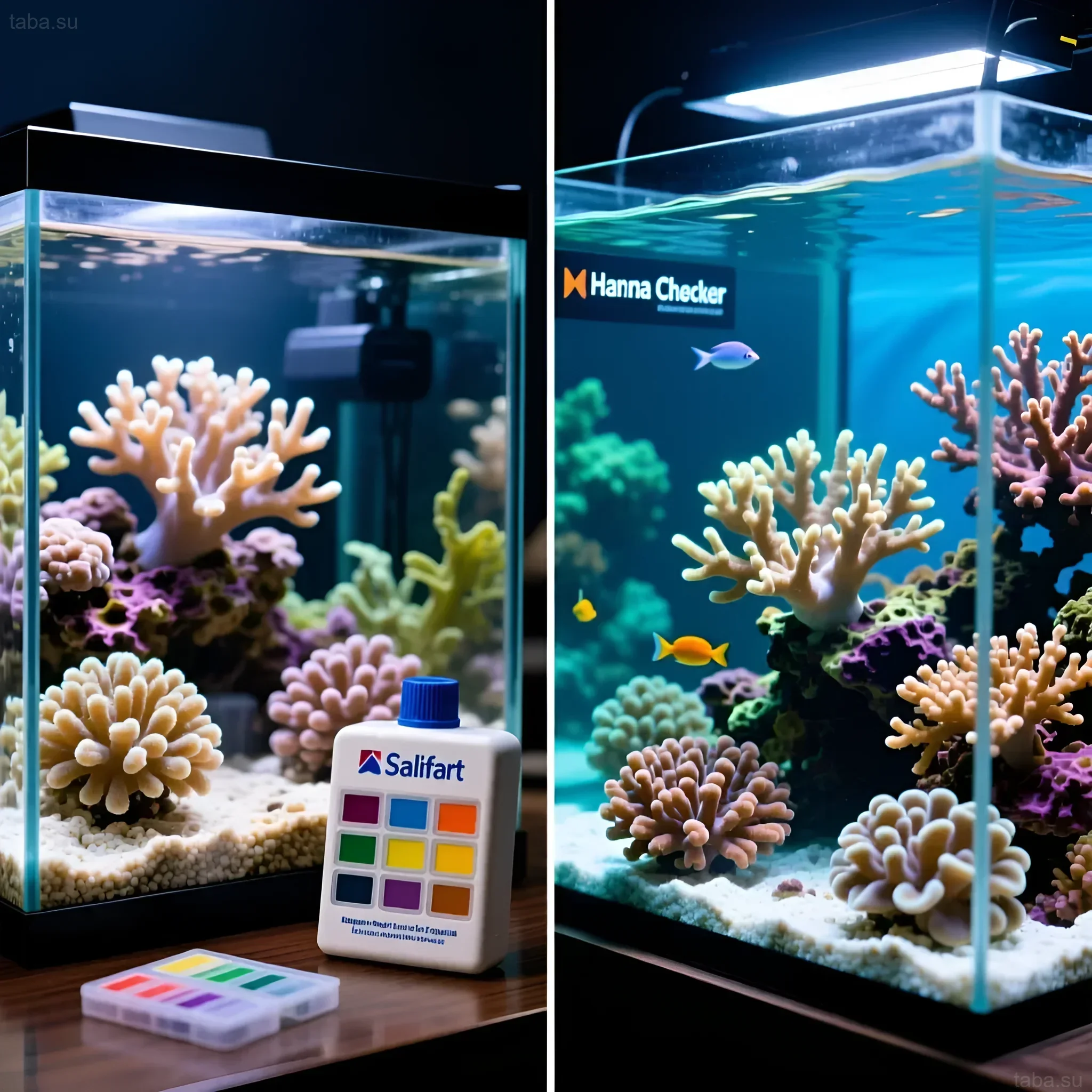
When choosing between the two systems, it’s important to evaluate them based on key characteristics, especially their ability to measure critical parameters (Ca, Alk, Mg) and nutrient parameters (NO3, PO4).
Comparative Characteristics of the Two Systems:
Parameter: Accuracy and Objectivity
- Salifert: Good, but depends on the operator and lighting.
- Hanna Checker: Excellent (digital), high repeatability.
Parameter: Measurement of Low Concentrations (PO4, NO3)
- Salifert: Satisfactory. Difficult to discern subtle color transitions at 0.03 ppm.
- Hanna Checker: Excellent (specialized Checkers, e.g., HI736, are designed for ultra-low ranges).
Parameter: Measurement of High Concentrations (Ca, Mg, Alk)
- Salifert: Excellent. Convenient titration method for these parameters.
- Hanna Checker: Good. Requires a separate device (e.g., HI755 for Alk).
Parameter: Initial Cost
- Salifert: Low (one test kit covers multiple parameters).
- Hanna Checker: High (requires purchasing multiple devices).
Parameter: Cost Per Test
- Salifert: Low.
- Hanna Checker: Medium/High (depends on the reagent).
6. Which Test to Choose: Recommendations for Different Levels of Aquarists

The choice of the optimal testing system depends on the aquarist’s goals, the type of reef, and their willingness to invest time and money.
Recommendations for Beginner Aquarists (FOWLR and Soft Corals):
At this level, simplicity and cost-effectiveness are important. The main focus is on nitrates and alkalinity.
- Choice: Salifert. An affordable starter kit allows for monitoring key parameters (Alk, NO3, NH4) without significant financial investment.
Recommendations for Experienced Aquarists (LPS and Mixed Reef):
More precise control of phosphates and the Ca/Mg/Alk balance is required.
- Choice: Hybrid System. Use Salifert for frequent tests of Calcium, Magnesium, and Alkalinity, as they are accurate and economical in this range. Add the Hanna Checker HI736 (Ultra-Low Phosphate) for precise PO4 monitoring, which is critical for preventing algae.
Recommendations for Professionals (SPS-Dominant Reef):
SPS corals (e.g., Acropora sp.) require perfect stability and ultra-low nutrient levels. Maximum accuracy and repeatability are crucial here.
- Choice: Full Hanna Checker Set for all critical parameters (PO4, NO3, Alk). Digital tests allow for detecting minimal changes that might be imperceptible with drip titration. Many professionals use Hanna for daily alkalinity measurements (HI755) as it is the most rapidly changing parameter.
7. FAQ: Answers to Frequently Asked Questions About Marine Aquarium Tests

Q: How often should water be tested?
A: The frequency depends on the aquarium’s stability. In a mature, stable reef, checking Ca, Mg, and NO3 once a week is sufficient. Alkalinity (Alk) should be checked more often – 2–3 times a week, as it is the most volatile parameter rapidly consumed by corals.
Q: Do Salifert and Hanna Checker reagents have an expiration date?
A: Yes. The expiration date is indicated on the packaging. Salifert reagents are generally more stable, but after opening the bottles, their activity may decrease, especially if stored in heat or direct light. Hanna Checker reagents in sealed packets are more stable, but they should also be used before their expiration date.
Q: Why don’t my Salifert and Hanna Checker results match?
A: The discrepancy can be due to several factors:
- Incorrect dosing in the drip test (Salifert).
- Difference in methodology: Salifert measures the total amount of a substance, while Hanna may be calibrated for specific forms.
- Error in sample preparation for Hanna (e.g., water droplets on the outside of the cuvette).
- Using expired reagents.
Q: Is it worth buying cheap Chinese tests as an alternative?
A: taba.su experts do not recommend using uncertified or excessively cheap tests, especially in reef aquariums. Inaccurate tests can lead to incorrect dosing of supplements, which will ultimately be much more expensive than purchasing quality Salifert or Hanna tests.
8. Interesting Facts and Expert Tips on Marine Water Testing
Testing accuracy is not only about reagent quality but also about following the correct procedure. Experts recommend considering the following points, regardless of whether you use drip tests or digital devices:
- Lighting during titration: When using Salifert, always conduct the test under consistent, preferably natural, lighting. Artificial light can distort color perception and, consequently, the result.
- Temperature stability: Always test water at room temperature. Water that is too cold or too warm can affect the reaction rate of reagents.
- Batch check: If you doubt a result, re-test using a freshly prepared sample and, if possible, compare the result with another test kit (e.g., compare Salifert Alk with Hanna Alk Checker).
- Hanna zeroing: When using a Hanna Checker, ensure you zero the device correctly. The cuvette must be perfectly clean, free of fingerprints and water droplets on the outside.
- Syringe rinsing: When using Salifert, always thoroughly rinse syringes and pipettes with distilled or RO water between tests to avoid cross-contamination of reagents.
Ultimately, the choice between Salifert and Hanna Checker comes down to a balance between accuracy, convenience, and budget. Salifert remains a reliable and economical workhorse for basic monitoring, while Hanna Checker offers unparalleled objectivity and precision, especially in critically low ranges, making it an indispensable tool for professional reef keepers.